Export documents from India
Export documents from India: the complete checklist
To export from India you need three kinds of documents. Registrations you get once (IEC, AD code, GST and LUT). Commercial documents you prepare for every shipment (commercial invoice and packing list). And shipping documents created during the move (shipping bill, bill of lading or airway bill, and a certificate of origin when the buyer or destination needs one).

Most customs delays at Indian ports are not caused by the cargo. They are caused by paperwork that does not match. This guide explains every document, what it is for, and who is responsible for it.
Part 1: One-time registrations
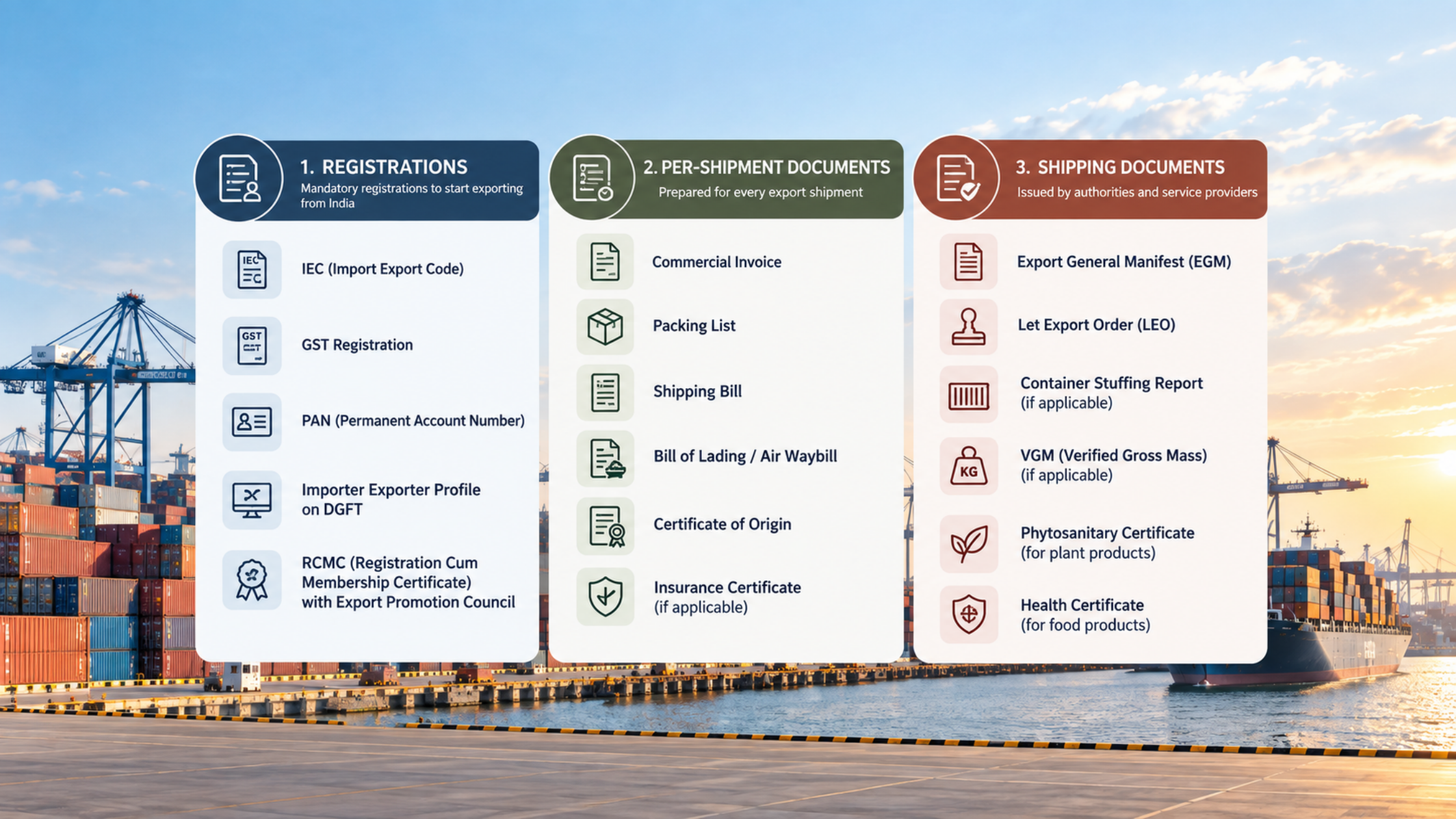
You set these up once, before your first shipment.
IEC (Importer Exporter Code)
A 10-digit code issued by the DGFT. You cannot clear an export shipment without it. It is applied for online and is linked to your PAN.
AD code registration
Your bank's Authorised Dealer code must be registered with customs at each port you export from. Without it, export proceeds and incentives cannot be linked to your shipment.
GST registration and LUT
Exports are zero-rated under GST. To export without paying IGST upfront, file a Letter of Undertaking (LUT) on the GST portal. It is renewed every financial year. Missing the renewal is a common and avoidable mistake.
RCMC (if you want incentives)
A Registration cum Membership Certificate from the relevant Export Promotion Council. You need it to claim certain government export benefits.
Part 2: Documents for every shipment
These come from you, the exporter.
Commercial invoice
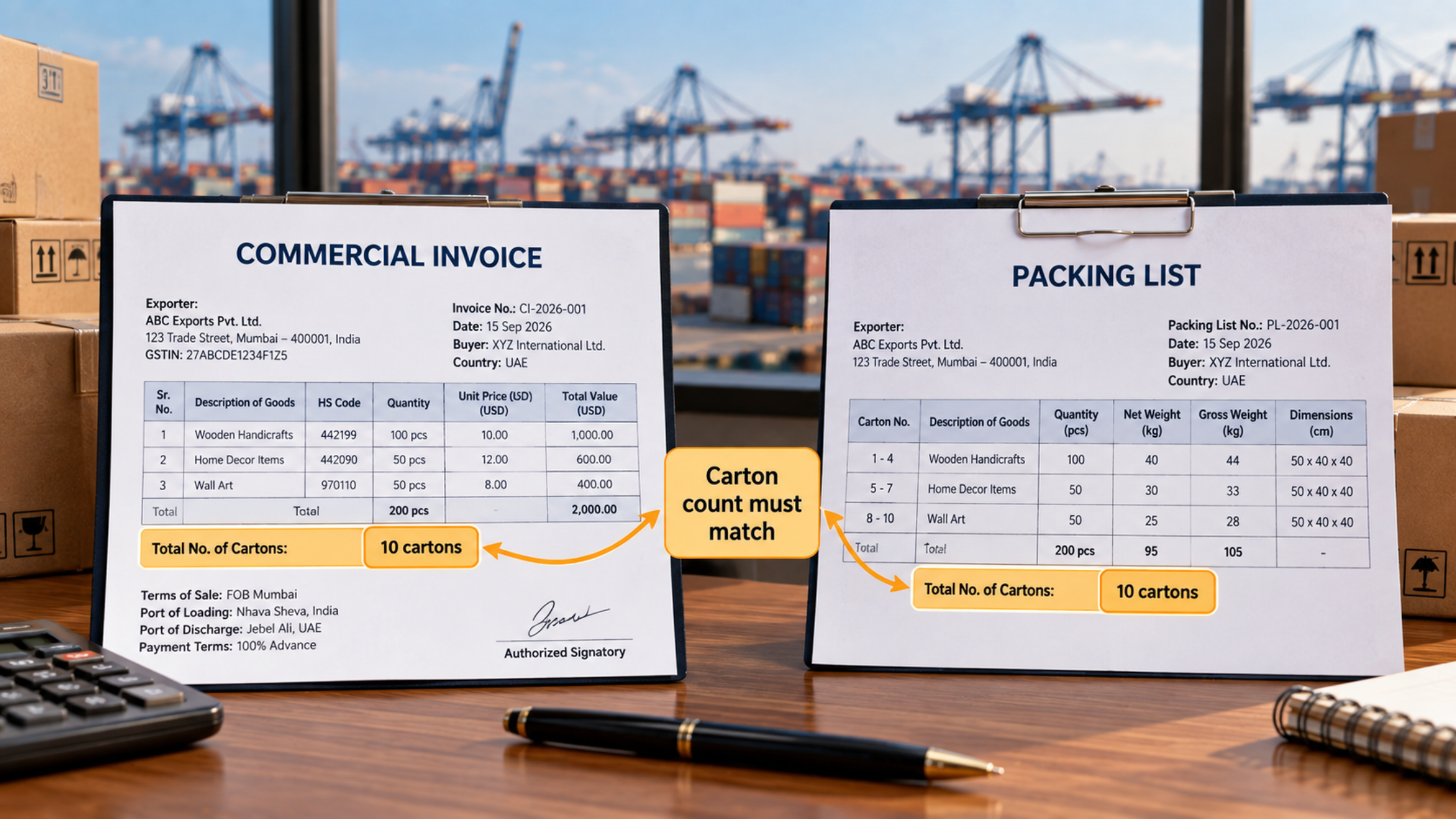
The core document. It shows the buyer, seller, description of goods, HS code, quantity, value, currency and Incoterm. Customs in both countries rely on it to assess the shipment.

Packing list
Carton by carton detail: number of packages, what is in each, net and gross weights, and dimensions.

The rule that matters most: the invoice, packing list and actual cargo must match exactly. A different carton count, a different weight or a slightly different product description is enough to trigger a customs query.
Part 3: Shipping documents
Carton by carton detail: number of packages, what is in each, net and gross weights, and dimensions.

The rule that matters most: The invoice, packing list and actual cargo must match exactly. A different carton count, a different weight or a slightly different product description is enough to trigger a customs query.
Shipping bill
The main export declaration, filed electronically on ICEGATE. Once customs clears it, they issue a Let Export Order (LEO), which means the goods can be loaded. Export incentives such as RoDTEP are also claimed through the shipping bill, so errors here cost money later.

Bill of lading (ocean) or airway bill (air)
Issued by the carrier or forwarder. It is a receipt for the goods and the contract of carriage. For ocean freight, an original bill of lading can also act as a document of title, which means whoever holds it can claim the cargo. That is why banks use it in letter of credit transactions.

Certificate of origin
Proves where the goods were made. There are two kinds:
- Preferential, used to claim lower duty under a trade agreement between India and the destination country
- Non-preferential, which simply states origin, and is often requested by buyers, banks or customs

India does not have a trade agreement with the US, so shipments to the US do not use a preferential certificate. Many US buyers still ask for a non-preferential one.

E-way bill
Needed to move goods by road within India from your factory to the port or container freight station, above the value threshold.

Other documents you may need

Depending on your product and your buyer:

- Letter of credit documents, if payment is by LC. Banks check every detail, and small errors lead to rejection
- Insurance certificate, if you are shipping on CIF or CIP terms
- Inspection certificate, if the buyer requires pre-shipment inspection
- Phytosanitary or health certificates, for food, agricultural and plant products
- Product specific approvals, for categories such as food, cosmetics, electronics or chemicals
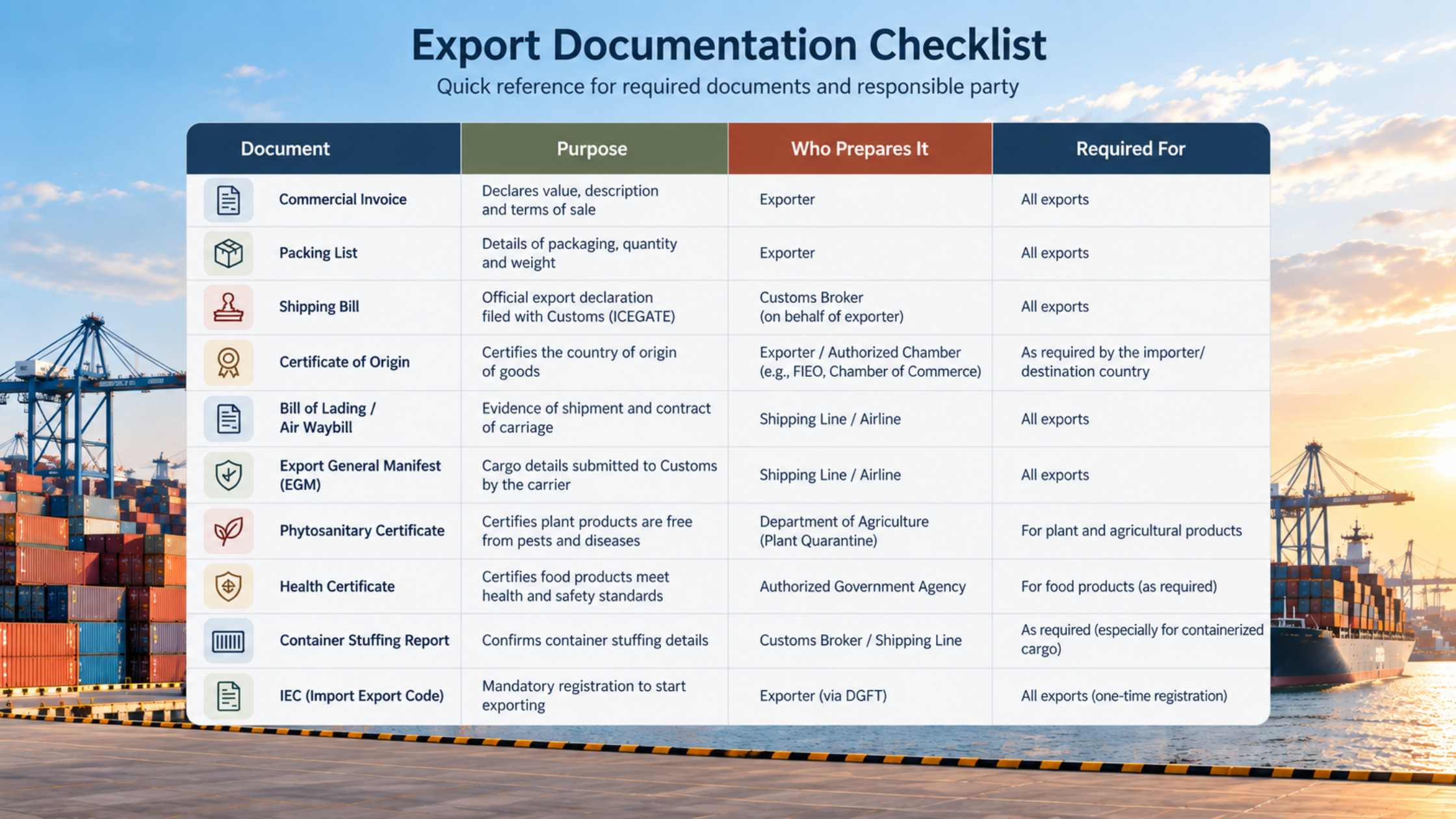
Quick reference table
| Document | Who prepares it | When |

| IEC, AD code, LUT, RCMC | Exporter | Once (LUT yearly) |
| Commercial invoice | Exporter | Every shipment |
| Packing list | Exporter | Every shipment |
| Shipping bill | CHA or forwarder | Before loading |
| Bill of lading or airway bill | Carrier or forwarder | At loading |
| Certificate of origin | Exporter, issued by chamber or EPC | Before shipment |
| E-way bill | Exporter or transporter | Before road movement |
The mistakes that cause delays
1. Invoice and packing list do not match the cargo
2. Wrong or vague HS code on the invoice
3. LUT not renewed for the new financial year
4. AD code not registered at the port being used
5. Product description too vague for customs to assess
6. Late documents from the exporter, leaving no time to correct errors before the vessel cut-off
Frequently asked questions
What is the most important export document?
The commercial invoice. Almost every other document is built from it, so an error there spreads everywhere.

Can I export without an IEC?
No, not for commercial shipments. A small number of categories are exempt, but regular exporters need one.

Who files the shipping bill?
Usually your CHA or freight forwarder, using the information on your invoice and packing list.

Do I need a certificate of origin to export to the USA?
Not a preferential one, because India and the US do not have a trade agreement. Your buyer may still request a non-preferential certificate.

How long does export documentation take?
With registrations already in place and correct documents, clearance can happen within a day. Errors and queries are what stretch it.
Want someone to check your paperwork?
Uni Traans Log handles export clearance in house. Send us your invoice and packing list before your next shipment and our team will
check them against the cargo and the destination's requirements before anything is filed.
business@utlgroup.in   +91 7400155630