Landed cost
How to calculate landed cost, with a worked example
Landed cost is the total cost of getting a product to its destination, not just the price you paid for it. It is the product cost, plus every freight, insurance, clearance, duty, fee and delivery charge until the goods reach the warehouse. Divide that total by the number of units, and you have the real cost per unit. For shipments from India to the US, landed cost is often a third or more above the factory price.

Pricing decisions made on the factory price alone are one of the most common reasons importers lose margin. The product looks profitable on paper, then the duty bill and destination charges arrive.
The landed cost formula
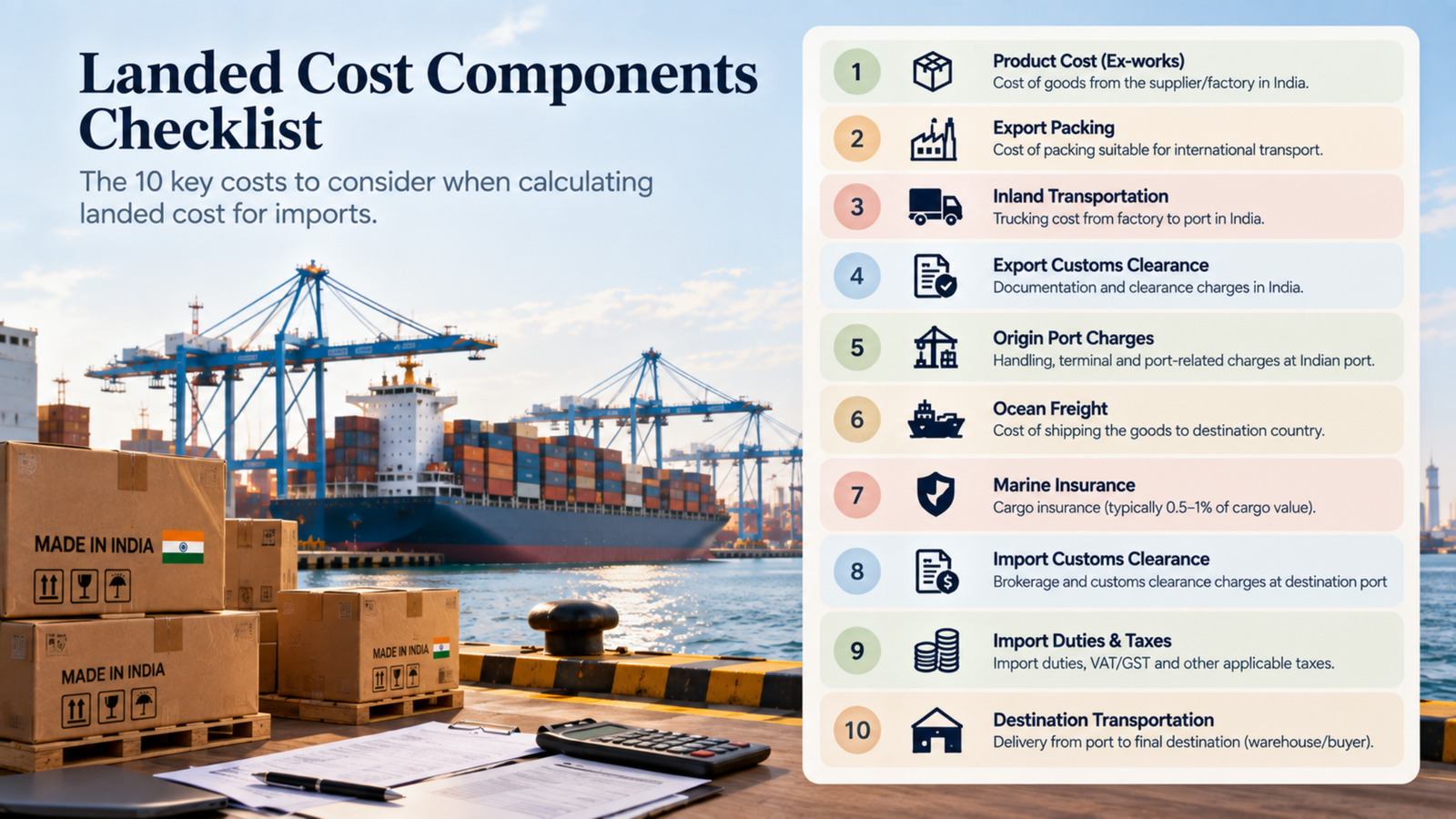
Landed cost = product cost + freight + insurance + duties and taxes + customs fees + destination charges + delivery

Each part is simple. The mistakes come from leaving parts out.
The components, one by one
1. Product cost
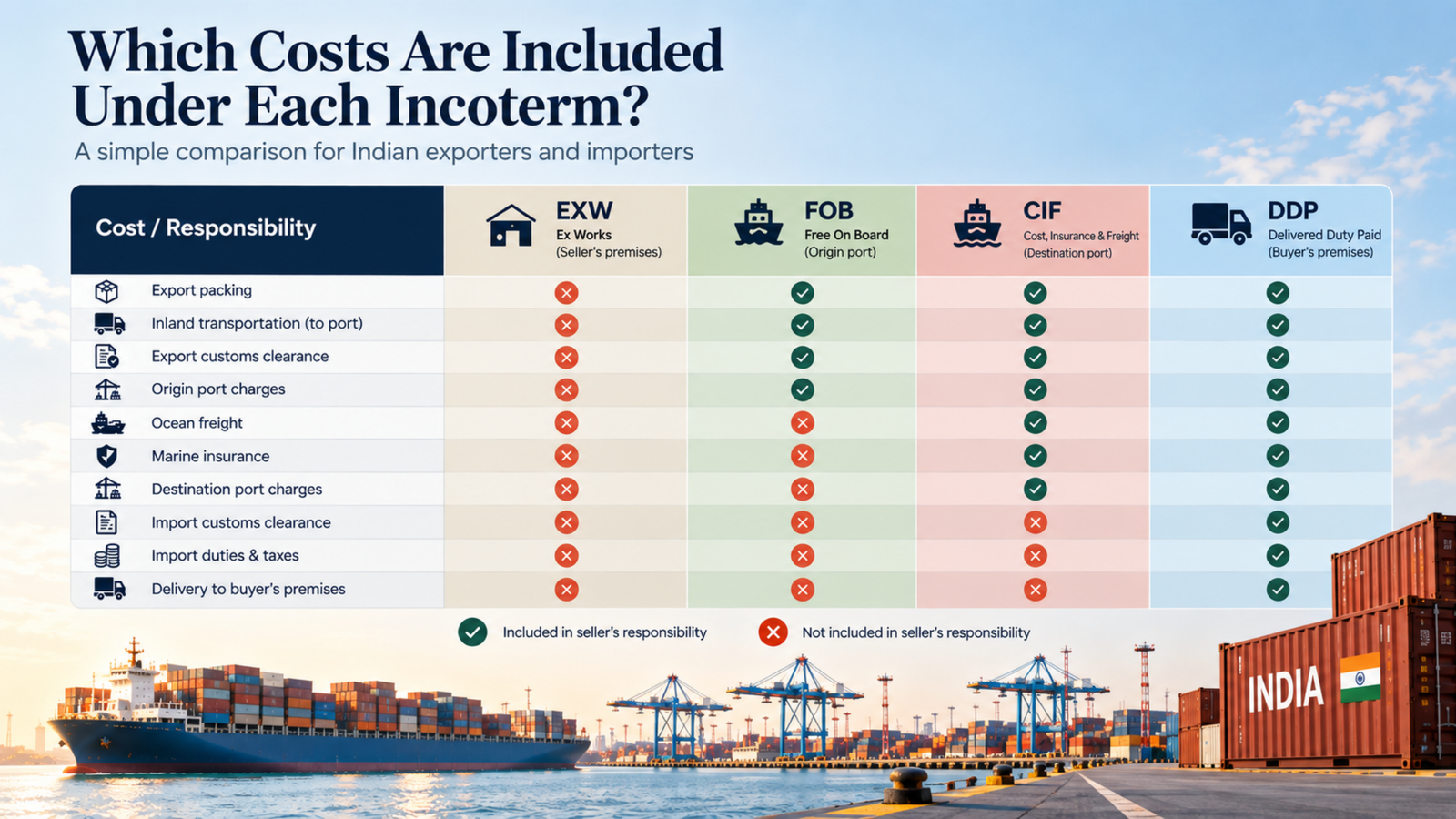
The price paid to the supplier. Note the Incoterm, because it decides which costs are already included.

- EXW (Ex Works): you pay for everything from the factory door
- FOB: the supplier covers inland transport, export clearance and loading in India
- CIF: the supplier also covers ocean freight and insurance to the US port
- DDP: the supplier covers everything, including US duty
2. Origin costs (if not included)
Trucking from factory to port, export customs clearance, port and terminal handling in India.
3. International freight
Ocean or air freight to the US. For ocean, check whether the rate includes surcharges such as fuel and peak season charges.
4. Cargo insurance
Often a small fraction of the goods value. Skipping it saves little and can cost everything. See our guide to marine cargo insurance.
5. Duties
Set by the HS code and country of origin. In 2026, the US has applied additional duties by country that sit on top of the normal rate, and these have changed several times this year. Always check the current rate for your code before you price.

One detail that surprises people: the US normally calculates duty on the transaction value of the goods, which excludes international freight and insurance. India and many other countries calculate duty on a value that includes freight. So the same shipment can produce a different duty base in each country.
6. US customs fees
- Merchandise Processing Fee: 0.3464% of goods value, within an annual minimum and maximum
- Harbor Maintenance Fee: 0.125% of goods value for ocean cargo
7. Customs broker, ISF and bond
Fees for filing the entry and Importer Security Filing, plus the cost of a single entry or continuous customs bond.
8. Destination charges
Terminal handling at the US port, documentation fees and, for LCL, deconsolidation charges.
9. Delivery
Trucking from the port to your warehouse or Amazon fulfilment centre.
10. Hidden and risk costs
Exam fees if customs selects the container, demurrage or detention if collection is delayed, and currency movements between order and payment.
A worked example
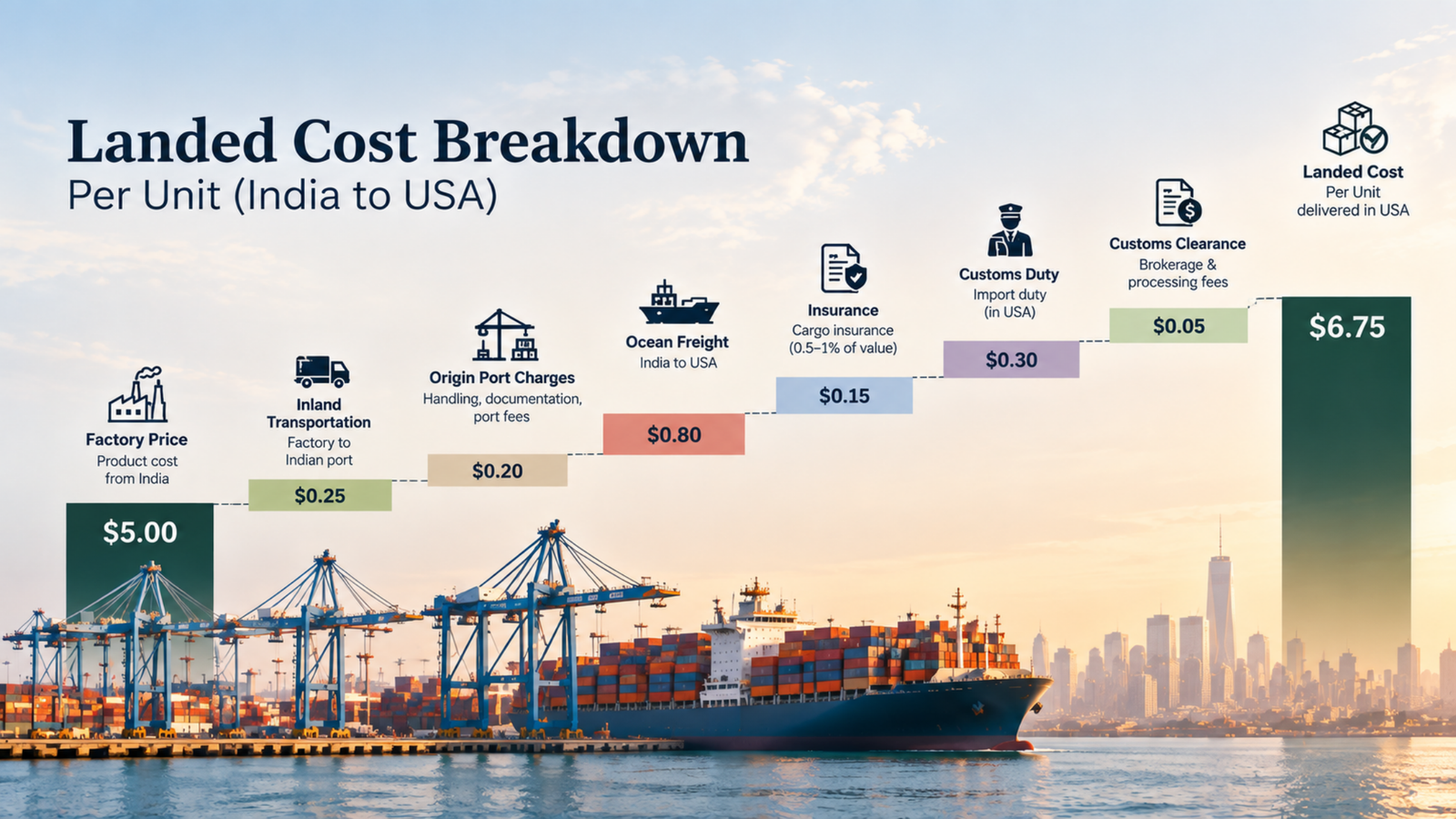
Here is an illustrative calculation for a 20ft container of cotton garments shipped FOB from India to a warehouse in the US. The freight and duty figures are assumptions for the example only. Your real numbers depend on the product, lane and date.
Shipment: 6,000 units, FOB value $30,000 ($5.00 per unit)
Cost item | Amount (USD) |

| Product cost (FOB) | 30,000.00 |
| Ocean freight (assumed) | 2,500.00 |
| Cargo insurance (assumed) | 60.00 |
| Duty (assumed 20% combined rate on $30,000) | 6,000.00 |
| Merchandise Processing Fee (0.3464%) | 103.92 |
| Harbor Maintenance Fee (0.125%) | 37.50 |
| Customs broker and ISF (assumed) | 350.00 |
| Single entry bond (assumed) | 150.00 |
| US port and destination charges (assumed) | 600.00 |
| Trucking to warehouse (assumed) | 700.00 |
| Total landed cost | 40,501.42 |
| Landed cost per unit | 6.75 |
The factory price was $5.00 a unit. The landed cost is $6.75, which is 35% higher. If this product was priced for sale on the basis of $5.00, most of the expected margin has gone.

Notice also which line is biggest after the product itself. It is not the freight. It is the duty. That is why classification and country of origin matter so much in 2026.
How to lower landed cost
1. Check the HS code. A correct code can change the duty rate. An incorrect one is a risk either way
2. Fill the container. Freight per unit falls sharply as utilisation rises
3. Compare FCL and LCL properly, including destination charges
4. Avoid demurrage by planning collection before the vessel arrives
5. Use a continuous bond if you import regularly
6. Recheck duties before each order while rates keep changing
Frequently asked questions
What is included in landed cost?
Product cost, freight, insurance, duties, customs fees, destination charges and delivery to your warehouse.

Is duty calculated on FOB or CIF value?
In the US, normally on the transaction value, which excludes international freight and insurance. Many other countries, including India, use a value that includes freight.

How accurate does a landed cost estimate need to be?
Accurate enough to price with confidence. Build in a small buffer for exams, delays and rate changes.

Should landed cost include Amazon fees?
Landed cost stops when the goods reach the warehouse. Amazon fulfilment and storage fees are selling costs and should be added separately in your margin calculation.

How often should I recalculate?
Every time freight rates or duty rates change. In 2026, that means before every order.
Want a real landed cost for your product?
Uni Traans Log can price the full journey from your supplier in India to your warehouse in the US, including duty, fees and delivery, so you can price your product with the real number.
business@utlgroup.in   +91 7400155630