Marine cargo insurance
Marine cargo insurance: what it covers and why you need it
If your cargo is lost or damaged, the shipping line's liability is limited by international rules to a small amount per package or per kilo, often far below what the goods are worth. Cargo insurance covers the actual value. It usually costs a small fraction of the shipment value, and it also protects you from general average, where you can be asked to pay towards a ship's losses even if your own cargo is fine.

Most exporters assume that if a carrier loses their cargo, the carrier pays. In practice, that almost never covers the loss.
Why the carrier will not pay the full value
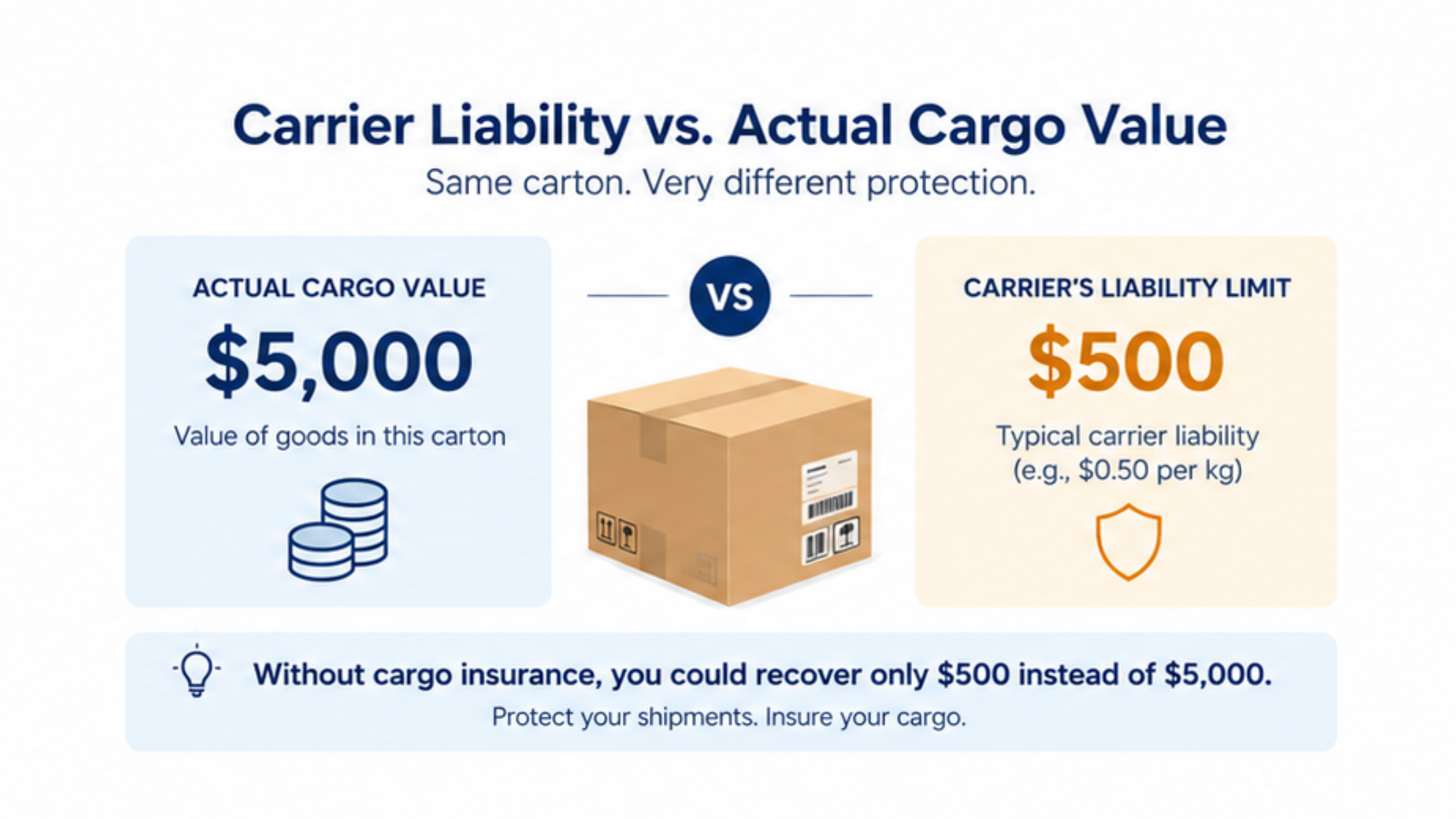
Shipping lines and airlines are protected by international conventions that cap what they must pay.

| Mode | Typical liability limit |

| Ocean, under the Hague-Visby Rules | 666.67 SDR per package or 2 SDR per kg, whichever is higher |
| Ocean, under US law (COGSA) | $500 per package |
| Air, under the Montreal Convention | A fixed amount per kg |

SDR is a unit set by the International Monetary Fund, worth a little more than one US dollar.

Carriers are also not liable at all for many causes of loss, such as bad weather, errors in navigation or fire, unless you can prove their fault. So a carton of electronics worth $5,000 lost overboard might produce a claim worth a few hundred dollars, or nothing.
What general average means for you
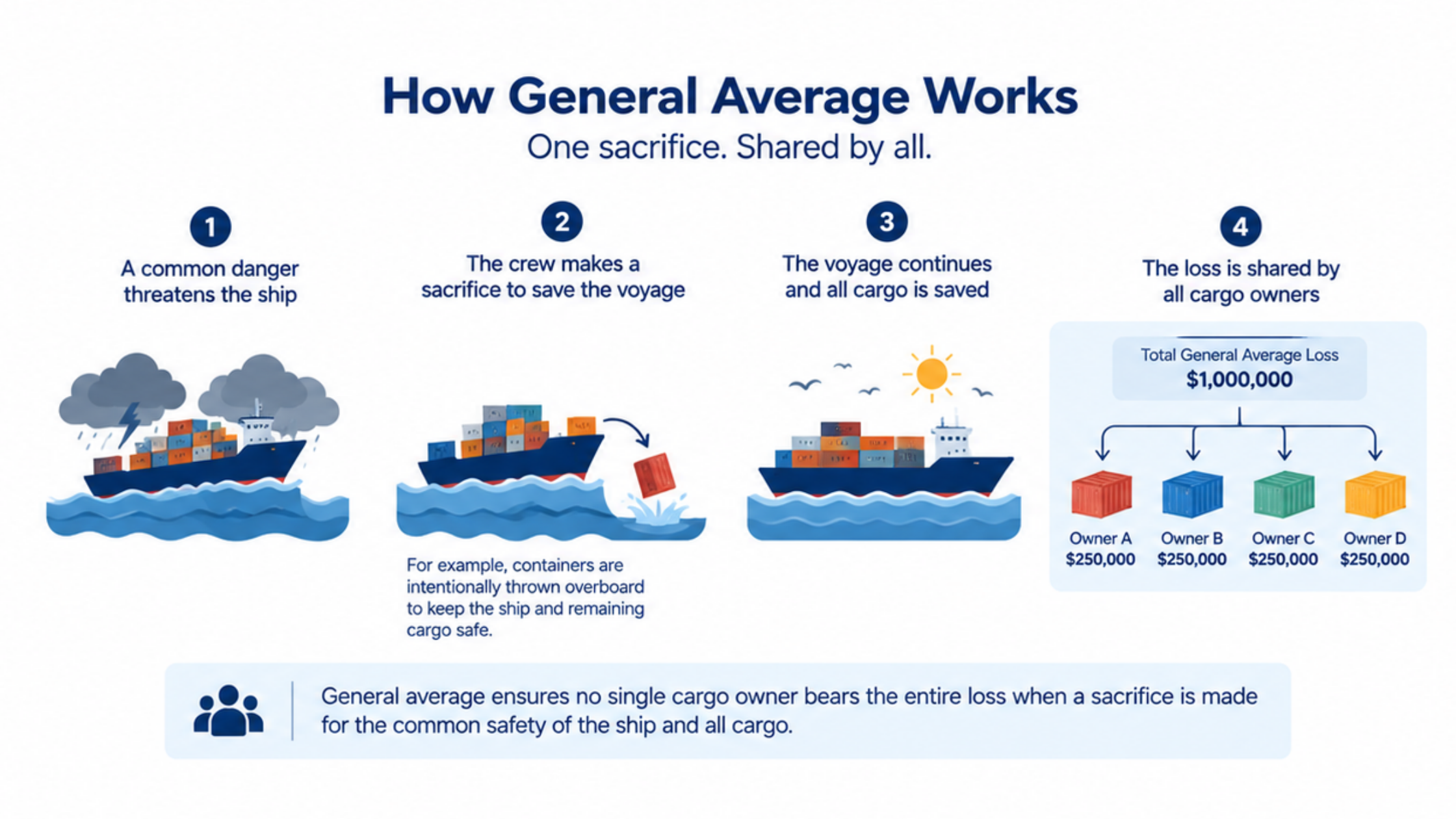
General average is an old maritime rule that still applies today. If a ship's master sacrifices cargo or spends money to save the vessel, for example jettisoning containers in a storm, fighting a fire or being salvaged, every cargo owner on board shares the cost in proportion to the value of their goods.

This means you can be asked to pay a contribution even if your container arrives in perfect condition. Until you provide security, the cargo is not released to you.

This is not rare. When the container ship Dali struck the Francis Scott Key Bridge in Baltimore in 2024, the owners declared general average, and cargo owners on board were asked for security before their goods were released.

With insurance, the insurer provides that guarantee and pays the contribution. Without it, you pay out of your own pocket, and your cargo waits until you do.
Clauses A, B and C: what each one covers
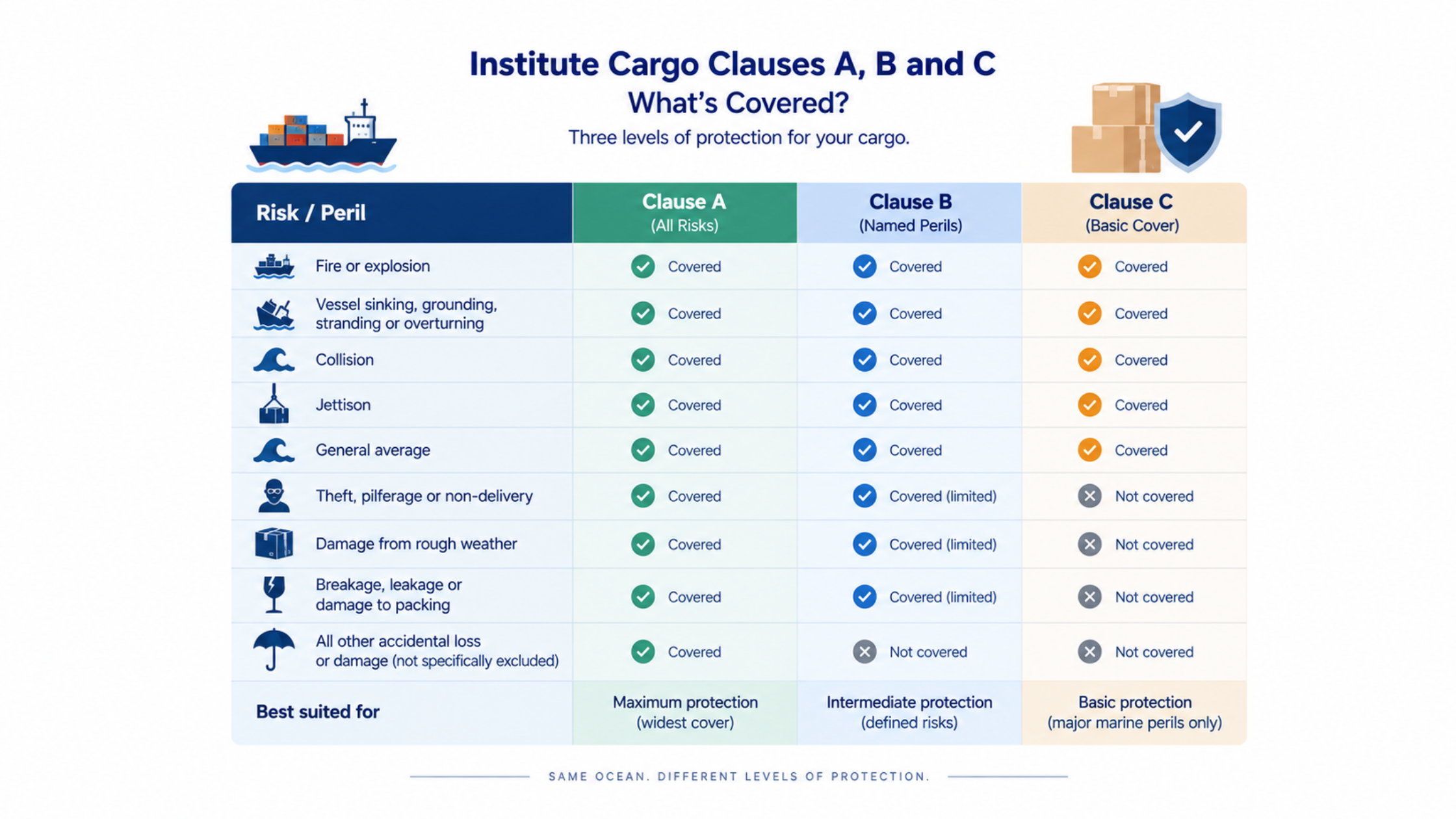
Most cargo policies are written on the Institute Cargo Clauses. There are three levels.

Clauses A (all risks). The widest cover. Protects against all risks of loss or damage except specific exclusions, such as poor packing, inherent vice (the nature of the goods), delay and wilful misconduct. Most exporters should choose this.

Clauses B. Named perils only. Covers events such as fire, sinking, collision, earthquake, water entering the vessel or container, and loss overboard.

Clauses C. The narrowest cover. Major casualties only, such as fire, sinking, collision and general average. It does not cover most everyday damage.

War and strikes cover are usually added separately.
Who should arrange insurance?
That depends on your Incoterm.

- EXW, FOB: the buyer carries the risk for the main journey and should insure it
- CIF: the seller must insure, but only to the minimum level, Clauses C
- CIP: the seller must insure to Clauses A
- DAP, DDP: the seller carries the risk to destination and should insure

Under both CIF and CIP, the insured value must be at least 110% of the contract value. If you are the buyer on CIF terms, check what the seller has actually bought. Clauses C may not be enough for you.
How much does it cost?
Premiums are usually a small percentage of the insured value. The rate depends on:

- The type of goods and how fragile they are
- The route and mode
- How well the cargo is packed
- Your claims history
- Whether you insure per shipment or with an annual open policy

Regular exporters usually save money and admin with an annual open policy that covers every shipment automatically.
How to make a claim stick
1. Pack properly. Poor packing is excluded from almost every policy
2. Photograph cargo at loading and on arrival
3. Note damage on the delivery receipt before signing. A clean signature makes claims harder
4. Notify the insurer immediately and keep damaged goods for survey
5. Put the carrier on notice in writing within the time limit
Frequently asked questions
Is cargo insurance mandatory for export from India?
Not by law. It becomes a contract requirement under CIF and CIP terms, and banks usually require it for letter of credit shipments.

Does my freight forwarder's insurance cover my cargo?
Usually not. A forwarder's liability insurance covers their own errors, not the full value of your goods. Ask for cargo insurance specifically.

What is the differnce between Clause A and Clause C?
Clause A covers all risks except listed exclusions. Clause C covers only major events such as fire, sinking and collision.

Does cargo insurance cover delays?
No. Delay and loss of market are standard exclusions.

Do I need insurance for air freight?
Yes. Airline liability is limited per kilo, which rarely matches the value of the goods.
Is your cargo properly covered?
Uni Traans Log can arrange cargo insurance with every shipment, or review the cover you already have against your Incoterm and
cargo value.
business@utlgroup.in +91 7400155630